Tanpura: The Divine Drone Instrument of Indian Classical Music
MusicChamps
Music Educator
Introduction
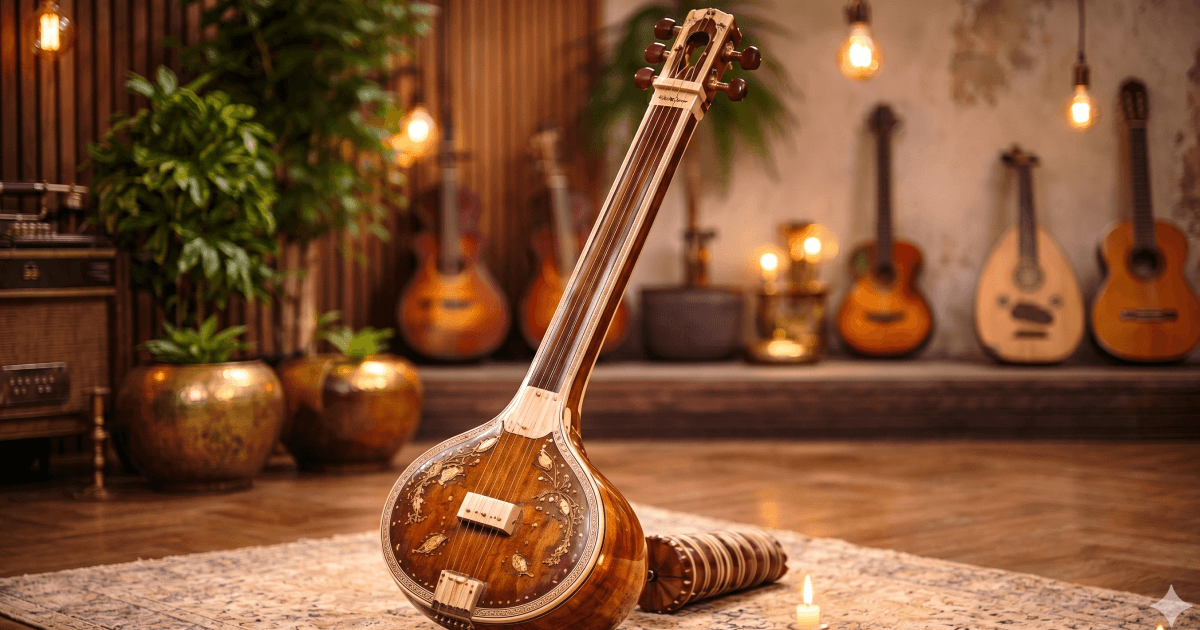
Have you ever thought about why the tanpura is called a tanpura? It is because the meaning of the word taan in Sanskrit is 'to stretch'. The tanpura is an instrument in which strings are stretched in different ratios so that sounds of different pitches can be produced. It has mainly 4 strings — but these four, when played, can take you to a whole new world of melody.
Origin of Tanpura
Few people know that tanpura is not the original name of the instrument. Earlier it was known as tambura or tanpuri, but with the evolution of the instrument, the name "tanpura" was widely adopted.
Have you heard of naad aradhna? It is a practice in which a person understands sound and its details to attain enlightenment. It is believed that the tanpura is not a man-made instrument but was gifted by the gods to the sages to perform naad aradhna and attain enlightenment.
Structure of Tanpura
To make a tanpura, a hollow gourd is dried and attached to a long wooden piece. Four strings are then stretched and tied from the mid-part of the gourd to wooden pegs called khoonta.
Tumba (Resonator)
The tumba is the gourd resonator of the instrument — made from a gourd or wood. Sound waves resonate inside and bounce back, forming an internal harmony. The size and quality of the gourd must be chosen carefully.
Dandi (Neck)
The dandi is a long, polished wooden piece attached to the gourd. It serves three purposes:
- Visual appeal of the instrument
- Base for string attachment
- Bridge between the gourd and the strings
Javari (Bridge)
A small bone-made bridge called javari is attached to the surface of the gourd. It keeps the strings at the required distance from the dandi, allowing them to vibrate freely.
Khoonti (Tuning Pegs)
At the top of the tanpura are large wooden pegs called khoonti. These are used to:
- Tighten or loosen the strings
- Act as the tying base for the strings
Strings
There are four strings in a tanpura, tuned to middle Sa, Pa, Pa, and higher Sa. When playing a raag in which Pa is vargit (omitted), the middle strings are retuned to Ma.
Additional Resources
Frequently Asked Questions
Why is the instrument called a Tanpura?
The word 'taan' in Sanskrit means 'to stretch'. Tanpura is an instrument in which strings are stretched in different ratios to produce sounds of different pitches.
How many strings does a Tanpura have?
A Tanpura has four strings, typically tuned to middle Sa, Pa, Pa, and higher Sa. When the note Pa is omitted in a raag, the middle strings may be tuned to Ma.
What is the difference between a male and female Tanpura?
Male and female Tanpuras differ in their tuning and structure. The male Tanpura is generally larger and tuned lower, while the female Tanpura is smaller and tuned higher to suit the female vocal range.